One of the deepest canyons in the world
One of the deepest canyons in the world : The department of Arequipa City Colca Canyon is located in the south of the country, with the following geographic coordinates: 70º48’15 “to 70º05’52” west latitude and 14º36’06 “at 17º17’54” south latitude;
Limits with the departments of Ica, Ayacucho, Apurímac, Cusco, Puno and Moquegua, in a length of 1,071 km.
By its north-east and south boundaries, by the west it presents an extensive coast to the Pacific Ocean of 528 km, representing 18.1 percent of the length of the Peruvian coast.Arequipa is conformed by 8 provinces:
Arequipa, Camaná, Caravelí, Caylloma, Condesuyos, Islay and La Unión, which have 109 districts; Has an area of 63 345 km2, representing 4.9 percent of national territory, with a population density of 19.2 inhabitants per km2;
his Geography is rugged, volcanic activity being an important factor in the configuration of its territory that is crossed from north to south by the derivations of the Western Cordillera of the Andes .
Around Arequipa City Colca Canyon .One of the deepest canyons in the world
The spectacular countryside around Arequipa rewards a few days’ exploration, with some exciting and adventurous possibilities for trips from the city.
Climbing El Misti is a demanding but rewarding trek, while the Inca ruins of Paucarpata at the foot of the volcano offer excellent scenery,
great views and a fine place for a picnic. The attractive village of Chapi makes a good day-trip, while the Sumbay
caves, just a few hours’ drive from Arequipa on the road towards Caylloma, contain hundreds of unique pre-historic cave paintings.
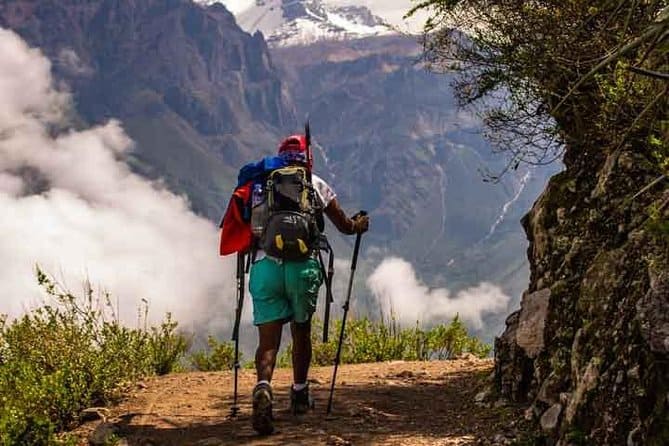
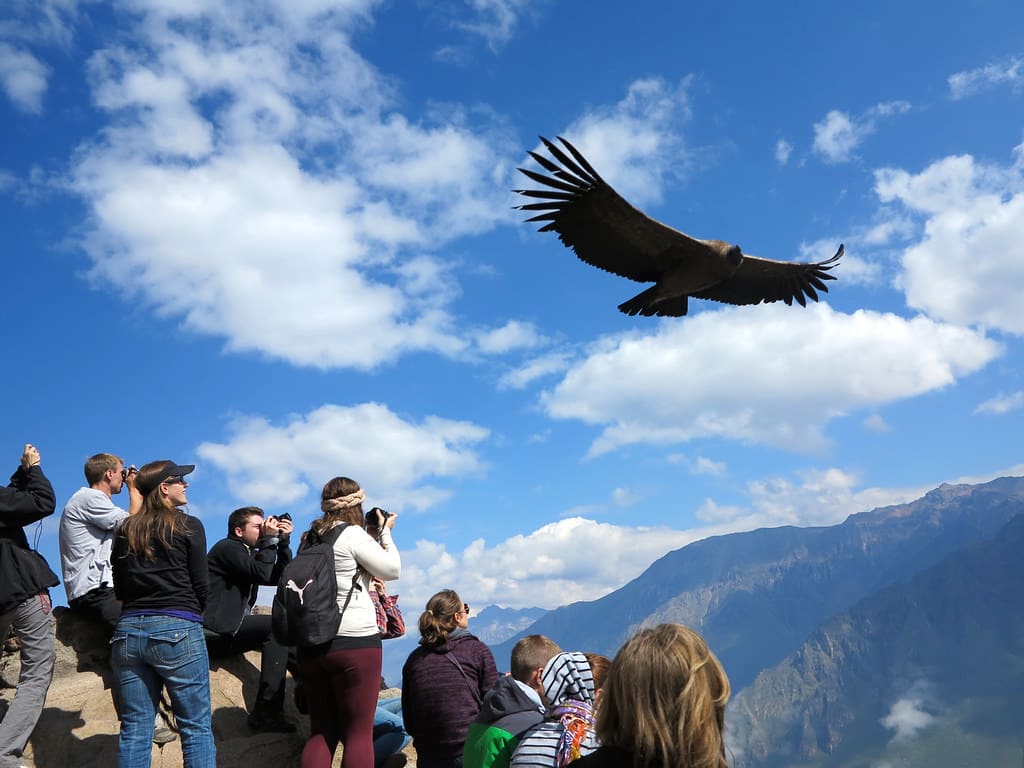
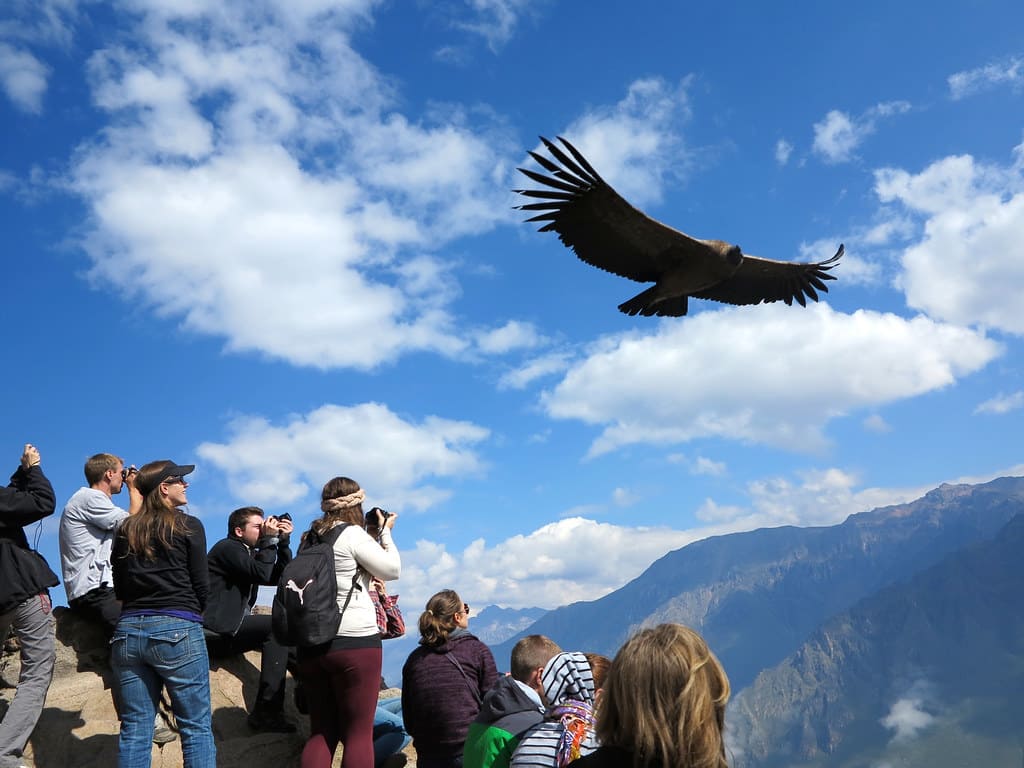
The Colca Canyon, One of the deepest canyons in the world
some 200km to the north of Arequipa, is second only to Machu Picchu as a major attraction, and developing fast as a trekking and canoeing destination (best in the dry season, May—Sept).
Called the “Valley of Marvels” by the Peruvian novelist
Mario Vargas Llosa -Arequipa City Colca Canyon .
it is nearly twice the size of Arizona’s Grand Canyon and one of the country’s most extraordinary natu- ral sights. Around 120km west of Arequipa, you can see the amazing petro-glyphs of Toro
Muerto, and perhaps go on to hike amid the craters and cones of the Valley of the Voléanos.A little further nortl
Canyon, which some people believe could usurp Coica deepest canyon in the world. Getting there Most people visit
these sites on an organized trip with panies in Arequipa (see box on p.256). Ifyou are preparei extra hassle, you
can visit many of the sites by much ch(port an buses from the Terminal Terrestre
in Arequipa daily via C1trip and down along the Coica Canyon to Cabanacondi these return from Cabanaconde two
or three times a day (check the times on or before arrival. Transportes Coica as do Turismo Milagros and Andalucia.
Angelitos Negros Juan de Dios -Arequipa City Colca Canyon
for Chapi at 6am and 7am Transp two or three buses a week to Toro Muerto, Valley of ti Cotahuasi Canyon from La Merced 301.
The most popular trip is without doubt to Chivay and The road to Chivay and Coica is itself always a fascinan cially
the first hour or so climbing high to the Reserva Blanca, where it’s usually possible to spot groups of wild pampa.
The next landmark is the crossroads where the trs Chivay or Cusco routes and the oíd road to Juliaca and Pition
it’s possible to make out the unusual volcanic ash sti the impressive cliffs on the northwestern horizon.
The junction -Arequipa City Colca Canyon.
bearing north and away from the more weste passing the access track down to the caves of Sumbay you’ll have to
camp, but if you have a vehicle it’s easy ene en route, following the signpost (at Km 103 from Arequifto the village of Sumbay about 1.5km.
At this find the guardián of the cave, frequently a young lad, for your car to continué another kilometre to a parking ten-minute walk to the caves, down into a small car bridge.
The guardián will have to unlock another gate to site. Although small, the main Sumbay cave contains a ser rock
paintings representing shamans, llamas, deer, pumas ; rounding countryside is amazing in itself;
herds of alpt around the plain looking for ichu grass to munch, and vasi of varying colours mix smoothly together with crudely Back on the main
Road to Chivay .Arequipa City Colca Canyon
the route continué used as breeding stations for vicuñas and alpacas the region’s highest pass at 4800m.
The occasional viscacha this point, darting between the many rocks and boulders Another rare species, the yapat
plant, can also be spotted al semi-spherical and looking like a cross between a brain the yapat plant is traditionally
used as a cooking fuel extinction and so only local peasants are allowed to utilize descends via a winding route
towards the Coica Canyon. before arriving at the valley floor, the first of the area’s fai cultural terraces can be seen, with the town of Chivay .
AREQUIPA: MAIN TOURIST ATTRACTIONS -One of the deepest canyons in the world .
The department bases its tourist potential on the heritage of pre-Hispanic culture and its natural riches.Tourism is
concentrated in the city, which is a pole of attraction for its ashlar buildings; The old city is located in the center,
where you can admire the colonial architecture in one of the best expressions of religious inspiration that reaches
not only the temples, but also the civil architecture, with mansions with covers characterized by a very high and decorated curved pediment.
Among the main cultural tourist attractions are:
Santa Catalina Monastery, considered a masterpiece of colonial architecture, since it was founded in 1579 until
1970, this small city frozen in time remained hidden from the world in severe closure.
After 400 years it was restored and opened to the public. It is a construction of ashlar with an area of more than
20 thousand square meters; It has 3 cloisters inside, almost a hundred cells arranged forming 6 streets and a passage, with a unique square.
The Cathedral, One of the deepest canyons in the world
built entirely in ashlar, its façade consists of 70 columns, 3 portals and 2 large lateral arches. It has true jewels in
images, sculptures and oil paintings by renowned artists.
Its main altar is made of marble from Carrara (Italy), its wooden pulpit is a sculptural beauty carved in France by
the artist Rigot and its organ was made in Belgium. It has a complete museum of religious art.
Iglesia de La Compañía de Jesús,One of the deepest canyons in the world
built between 1654 and 1698, is the symbol not only of mestizo art but also of plateresque art in Latin America,
where the grotesque on the ashlar is the symbiosis of indigenous and
Hispanic cultures. Among its jewels are paintings by Bernardo Vitti and the image of the Cristo del Buen Morir of “
El Montañez”
La Merced Church and Convent,
of sober styles, dates from the 16th century. Its chapter house is one of the most beautiful in the region, due to its
Gothic style, it has a valuable library and paintings from the Cuzco school.
Temple of San Agustín,
with plateresque and mestizo frontispiece. The main cloister of the Augustinians served to shelter the
intelligentsia of the 19th century with the Lauterana Academy, origin of the University and the Bar Association.
San Francisco Complex,
the Church of late romantic style with a beautiful façade in ashlar and brick, in a mestizo style with Mudejar
influence; the choir is made of ashlar with essays of baroque style;
In the presbytery there is a beautiful embossed silver altar.
The Convent, like the church, dates from the 16th century with large cloisters and silver jewels of religious art, a
site museum, art gallery and a library with more than 20 thousand volumes.
Barrio de San Lázaro,
is the first neighborhood of Arequipa and was established before the Spanish foundation of the city. It has a
unique architectural beauty for its mansions, narrow streets and passages, in addition to its small squares. Built of white ashlar and paved with black cobblestones.
The houses are externally decorated with pots of geraniums and other flowers. You can see a small ashlar bridge
where a fast water stream crosses that joins the Hermitage and its Plazuela with the rest of the neighborhood.
Church of Santo Domingo, one of the most beautiful in Arequipa, built in 1697, with three naves and interior cloisters.
Arequipa – Recoleta Convent and Temple,
built in 1647, in its cloisters, Alcantarino and Las Misiones treasures valuable jewels from different eras. Also
notable for its Pre-Columbian Museum with archaeological collections.
Casa Goyeneche, the portal has a horizontal balcony that occupies the entire width of the façade and seems to
be both a cornice on the ground floor, with wrought iron railings.
It is the Regional Headquarters of the Central Reserve Bank of Peru, in which a Museum has been installed with a
sample of the important cultural heritage of the Bank,
it has four rooms; Among them, the Hall of Pre-Inca and Inca Cultures exhibits important pieces from Ancient
Peru of the Chavín, Virú, Vicús, Moche, Nazca, Recuay, Chimú and Inca cultures.
In the Numismatic Exhibition Hall you can see a synthesis of the history of currency in Peru. The Pinacoteca
Room with valuable paintings from the Viceroyalty period by anonymous authors.
The Founder’s Mansion, One of the deepest canyons in the world
was owned by the founder of Arequipa Don Garcí de Carbajal (1540), its environments allow you to imagine the
colonial past. Between 1585 and 1767 the Jesuits built a church inside.