Full 1
MANU TOURS
MANU TOUR ZONE RESERVED 4 DAYS
Full 1
previous arrow
next arrow
Shadow

The Amazon River – Manu Jungle Trips

The Amazon River – Manu Jungle Trips

Amazonas Perú .

Arrives is home to approximately 25,000 plant species (10% of the world total) with 30% endemism. Of , 4,400 species are very useful and known properties in the The Amazon River – Manu Jungle Trips . Wildlife of Peru comes

to occupy the first place or number one in diversities of fish species (close to 2,000 species, and 10% of the world total); regarding the avifauna it is the second with more than (1,736 species); and third in amphibians (332 species); in third place in mammals with (460 species); and fifth place in reptiles (365 species) all these endemic / non-endemic species developed in the Amazon for many years ago . Tour Manu Park

The Amazon River – Manu Jungle Trips:

  is the largest river in the world, with the highest water volume, as well as the deepest. Its origins are in Peru, in the

region of Arequipa, province of Cailloma, on the snow-capped Mismi mountain, in the Carhuasanta ravine (river of the same name) at 5,597 m.a.s.l. (15°30’49”S and 71°40’36” W) This young river, essentially Andean, later

develops into the Apurimac River, which then forms the Ene River as it meets the River Mantaro. The Ene River then intersects with the Perene and the Tambo Rivers, and when it meets the Urubamba forms the Ucayali, finally joining the Maranon to be called the Amazon River – Manu Jungle Trips.

The Amazon River .

has a total length of 6,762 km, but only 3,713 km of this total is found in Peru. The delta that forms at the river’s

mouth as it flows into the Atlantic Ocean is 324 km wide and its plume goes almost 100 km out into the Ocean, draining 220,000 m3/s. Basin in Peru includes the basins of the Rivers Ucayali-Apurimac (its origin), the Maranon

Basin, the Madre de Dios River basin (on the Brazil- Bolivia border) and the basin of the River Putumayo (on the Colombian border).

The Amazonia River 

 Its tributaries, with more than 50,000 km over its trajectory, form the most extensive network of navigable rivers on the planet. Its waters feed off the rain drainage that bathes its basins and the melt-water from the thawing of the eastern and central snow-capped mountain slopes of the Andes. They also feed off water from

North of the equatorial line, that forms part of its drainage area. The narrower river-bed of the Amazon (during the dry season) has a width that varies between 2 and 5 km and a depth that fluctuates between 10 and 30 meters. The

wider river-bed (in rainy season) is characterized by extensive flooding of various kilometers of the land

bordering the river, leaving only small elevations of higher land above water. Due to the denseness of the vegetation however, these flooded areas are not visible.

The Amazonia

, like the other rivers in the rainforest, has sand and mud at the bottom of its river-bed. This base moves from the shores to the centre forming small islands where trunks and branches that are swept down the river at great speeds accumulate. These rivers are among the most important Peruvian tributaries of the Amazon Rainforest Adventure:

Napo:

the largest of the tributaries originatingIn Ecuadorian territory, southeast of Quito. It becomes Peruvian when it intersects with the Yasuni River. Further on. the waters of the Aguarico River flow into it (at one point forming the

Peru-Ecuador border). The Napo River is navigable along its Peruvian  Amazonia trajectory (Orellana, discoverer of the

Amazon navigated along this river) and its width ranges between 1.5 and 3 km. Putumayo: this river finctions as a boundary between Peru and Colombia, flowing into the Amazon in Brazil. It originates in the Colombian Andes (Nonhem Hem’Ocere – and its length in Peru is 1.380 km. while us width varies between 200

and 800 metres in amazon rainforest adventure.

Itaya: originating in Sana (region of Loreto this river travels almost parallel to the Amazon for a stretch of its trajectory and flows into it south of the city of Iquitos its length is 150 km.

Nanay: this river is 3T0 km long and flow s into the Amazon north of Iquitos and jungle trips.

Yavari- Yaquerana: denoting part of the border between Peru and Brazil, this river extends for 1,200 km.

Yurua: it originates in Peru and courses into Brazil to join up with the Amazon adventure.

Purus: also originating in Penn. ir territory. it flows into the Amazon after it enters Brazilian territory Peruvian segment of this amazon rainforest

The Rainforest Wasp

The Rainforest Wasp .

The Rainforest Wasp in Amazon Jungle:

 Local species richness and between-site similarity in species composition of parasitoid The Rainforest Wasp (Hymenoptera: Ichneumonidae; Pimplinae and Rhyssinae) were correlated with those of four plant groups (pteridophytes,

Melastomataceae, Burseraceae and Arecaceae) in a western Amazonian lowland rain forest mosaic  The mosaic structure of the forest was related to variation in soils within the non-inundated terrain. Significant matrix

correlation between patterns in parasitoid wasp species composition and plant species composition was found in jungle. Most of the overall correlation was due to idiobiont parasitoids of weakly concealed hosts, which

attack host larvae and pupae in exposed situations,with two of thefour ecologically defined parasitoid groups showingno correlation at all. A positive correlation between the number of plant species and the number of

Pimplinae and Rhyssinae species at a site was found when the latter was corrected for collecting effort. Consequently, the degree of floristic difference between sites may be indicative of the difference in species

composition of ichneumonids, and the species richness of plants may serve as a predictor of the species richness of parasitoid wasps. Although these results were obtained in a mosaic including structurally and floristically clearly

different types of rain forest,

the correlation coefficients were relatively low, and the present results lend only weak support to the idea of using plant distributions as indicators of animal distributions with jungle trips. There are several ways in which the

patchily distributed plant communities may affect the distribution of parasitoid wasps. Species richness and architectural complexity of the vegetation are expected to increase the number of available niches both for

herbivores and their parasitoids (Hawkins 1988), and variation in these vegetation properties may affect the cues that parasitoids use for host location (Gauld 1991, Vinson 1976). There is some experimental evidence that the

herbivore-induced volatiles of different plant species may attract different parasitoid species (Godfray 1994). In addition, many specialized herbivores sequester secondary chemicals from their food plants for protection against

predators and parasitoids, which may force the parasitoids to specialize on hosts that feed only on a limited range of (patchily distributed) plant species (Gauld et al. 1992). Correlation between plant and parasitoid species richness

and the patterns in their species compositions would support the idea that such niche differentiation is an important factor in explaining the high diversity of parasitoid wasps in Peruvian Amazonia.

Wasps in cloud forest lowland .

Wasps can be nasty stinging pests spoiling a summer’s day in jungle trips, but they are just one of a group of insects, including ants and bees, or Hymenoptera, the second most diverse insect order (circa 100.000 described

species). It’s hard to generalize about such a diverse group. wasps vary greatly in size from the tiny to the worryingly large. Some species build large intricate nests, others build simple ones and many build none at all in

jungle. A few wasp species are solitary, such as potter wasps in amazon rainforest. Most are communal, living in hives of from five or ten individuals to many tens of thousands. Although hive wasps operate a caste system incorporating a queen,

workers and so on, each species has its own unique live history in amazon rainforest. Some live by scavenging, others live by robbing ants or other insects of larvae in jungle. Minute non-communal parasitic wasps, able to fit in

this printed lay their eggs in a caterpillar which then produces dozens more tiny wasps instead of a moth or a butterfly in manu. Before they emerge from the caterpillar, the tiny maggots are in turn parasitized by another kind

of wasp – a hyperparasite in amazon rainforest. Another highly specialized group of tiny wasps (Cynipidae) – gall wasps – lay their eggs in tree branches and, by some unknown chemical means in jungle, force the tree to produce

a spongy amorphous tissue called a gall. Safely within this chamber the wasp maggot will develop into an adult to continue the cycle in jungle trips. That is if it escapes predators or parasites, at least one of which may well be

another wasp .some wasps have coevolved, creating fascinating relationships in jungle peruvian. Fig trees (Flrassp), fairly

common in the rainforest,

display a remarkable symbiotic relationship with fig wasps that are about the size of a match-head in amazon rainforest of Peru. Inside the hard and gourd-like fig are minute, composite flowers which are female, male or

sterile. Despite having male and male flowers side-by-side pollination cannot occur because the female flowers mature earlier than the males. A few of the flowers are sterile and are used by the previous generation of female

fig wasps to lay eggs in. The male wasps hatch first and inseminate the still unborn female wasps. As the females hatch at precisely the same time that the male flowers reach maturity, they exit the flower laden with pollen in

search of another searching for a sterile flower in which to lay her eggs, the female deposits her precious pollen cargo on female flowers.

After laying her eggs the female fig-wasp dies,

at least if she isn’t finished off first by one of the parasitic male fig wasps roaming around inside the fig looking for partners to mate with.

Each fig tree relies on just one species of wasp to do the pollinating. According to tropical biologists Forsyth and Miyata, around 900 kinds of neotropical fig tree are known, so there must be at least 900 fig wasps to go with each tree species.

Amazon Expedition Flora Fauna

Amazon Expedition – Flora Fauna

Amazonia rainforest Flora  and Fauna .

 The Amazon  Expedition flora  fauna  is basin is characterized by the largest expanse of tropical rainforest and one of the main sources of biodiversity. The region is home to countless species of insects, plants and animals interacting in a coordinated and balanced manner.

Biodiversity  Amazon  Manu – Amazon Expedition – Flora Fauna .

The effect of the tides of the Atlantic at the mouth of the Amazon is at its highest level with the phenomenon called Pororoca. “Pororóká” in Tupi Guarani language, means – loud bang – This term is used to describe the

penetration of Atlantic waters in the channel of the Amazon River during the time of high tide or flow. The Pororoca is more intense when the river flow are less, so the Atlantic ocean waters can penetrate more easily and

with greater speed and length in the channels of the delta of the river, which gives rise to a flood that filled with salt water many coastal areas. The Amazonian freshwater causes the seawater forming waves break over

them, which translates into strong opposition from both opposition that is causing the noise and the name of the phenomenon. For this phenomenon to occur, they have to attend several factors: the phases of moon or new

moon, which give way to the rise of the strongest tides, ocean currents and the opposition over the River Ocean.

Amazon Manu rainforest.

The Amazon basin is regarded as having the greatest plant diversity on the planet. It described some 30,000 different species, representing one third of all species of South America. Most plant species that inhabit the

floodplains are unique and are limited to this system. Also, few lowland species also exist in the highlands, which contributes to increasing the diversity of the Amazon flora in jungle trips. Factors that influence the distribution of

these plants and the composition of their communities deal with the geology and characteristics of rivers that bathe. The floodplains of the rivers of “white water”, for example, differ markedly from those of “black water” in

both species composition and the size of them. The first generating higher forests, perhaps because of the greater amount of nutrients carried by rivers, compared to rivers in nutrient poor “black water”. Existing floodplain species

are specially adapted to survive long periods underwater. This partly explains the marked differences in these plants with relatives of the regions high. No one knows for sure the total number of plant species in the Amazon

floodplain. One approach, nothing exaggerated, leads us to estimate that there are at least 5,000 plant species or riparian floodplain, with the actual figure certainly superior with manu jungle trips. Found in the Amazon rainforest

species of larger trees in the world,

as the “Lupuna” that can reach over 50 feet high. We also find a variety of trees whose wood is so durable and luxurious, they have earned the top spot acceptance in national and international local timber industry, causing

overexploitation and not just putting them in danger, but also the ecosystems that house  Mahogany, cedar and screw, are some of them. Special mention should be made of trees and medicinal plants, traditionally used by

Amazonian peoples to fight the evils facing them. The variety and species richness are endless, but here mention the Chuchuhuasi, Sangre de Drago, Copaiba, ABUTA Ayahuma and nutrients, either on land or in water, (Chorisia

integrifolia) (Swietenia macrophylla) (Cedrela odorata) (Cedrelinga catenaeformis) (Maytenus macrocarpa) (Croton lechleri​​) amasisa (Erythrina fusca) (Copaifera paupera) (Couroupita guianensis) (ABUTA grandifolia). Unlike trees,

most aquatic weeds require high levels to survive. Many float freely on the surface and, in the case of certain aquatic plants are able to detach from the substrate when the depth of water increases significantly (avoiding

choking). The buoyancy, of course, is the adaptation that allows these plants to handle changing water levels, and to achieve considerable success in its natural dispersion. One of the plant communities with greater expansion in

recent years has been the herbaceous. This is due in part to the increasing deforestation of the banks. When the

forest is cut, the light varies, allowing this type of plant colonization of new areas.  Tour Tambopata Macaw clay Lick 

Amazonia  Trip Peru .Amazon Expedition – Flora Fauna

The largest animal group in the Amazon is the bird. The Amazon basin is the hostel over 1300 species of birds, making the great valley of the Amazon the richest region of the Earth in this animal group. Only in Peru have been

reported to Amazon level a total of 806 species of birds. At least a third of these species live or visit seasonally

floodplains  mazon Expedition – Flora Fauna. The need to migrate from North America and the southern tip of South America, as well as seasonal migrants who spend the year between the flooded forest and offshore areas.

The Amazon Rainforest: A Treasure of Biodiversity and Unique Species

The Amazon rainforest, considered the “lungs of the planet,” is an ecosystem of unparalleled richness and biological diversity. Known for its vast territory spanning several countries in South America, it is home to an

astonishing number of animal species, some of which exist only in this corner of the world.

If you are a nature lover, you cannot help but marvel at the wildlife that inhabits this tropical paradise.

A Home for Life: 427 Species of Mammals, 1300 Species of Birds, and Much More  -Amazon Expedition – Flora Fauna

The Amazon rainforest is home to approximately 427 species of mammals, ranging from the smallest insectivores to majestic felines.

One of the most iconic is the jaguar, a large predator that symbolizes the jungle, known for its agility and strength.

This big cat, along with other mammals such as the sloths, who spend most of their lives hanging from trees, and the river dolphins, which inhabit the waters of the Amazon, represent only a fraction of the mammals that find refuge in this tropical jungle.

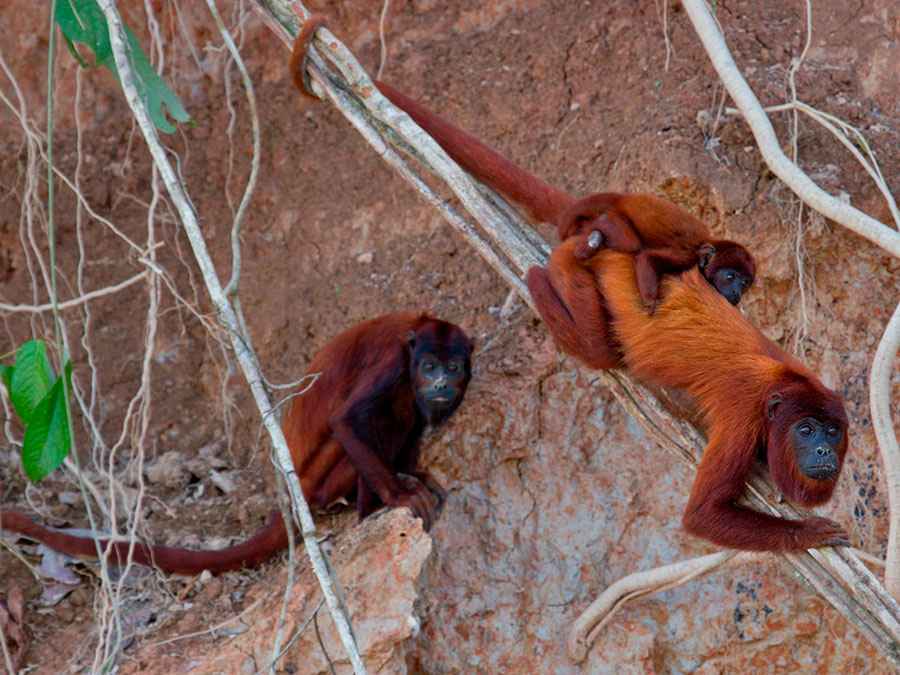
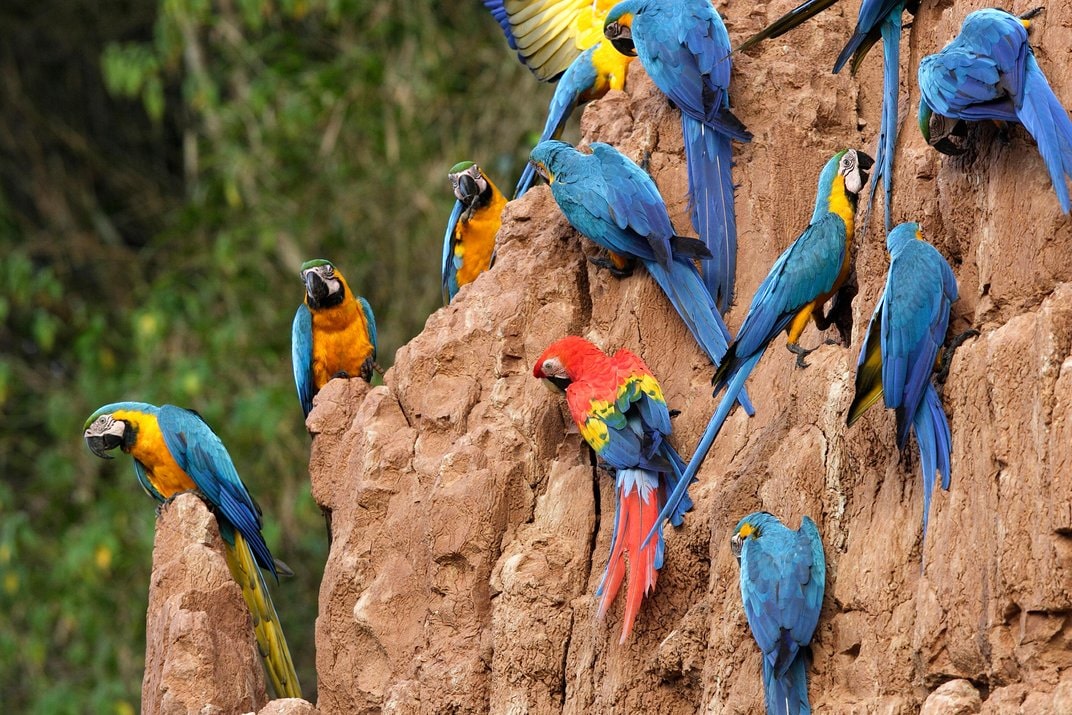
In addition to mammals, the Amazon rainforest is home to an amazing variety of 1300 species of birds. Among them, the colorful macaws stand out, flying between the treetops, as well as a large number of tropical birds that add life

and color to the jungle environment. Birds are not only a crucial part of the ecosystem but also one of the greatest attractions for birdwatchers and ecotourists around the world.

Reptiles and Amphibians: A Fascinating Subterranean and Aquatic World

The diversity of 378 species of reptiles is another aspect that makes the Amazon rainforest unique. From the feared

anacondas, some of the largest snakes on the planet, to the small and stealthy iguanas, every corner of the jungle is home to fascinating reptiles that have adapted perfectly to their environment.

But the Amazon is not only home to reptiles; it is also a refuge for over 400 species of amphibians. Among the best-

known are the glass frogs, whose transparent skin allows you to see their internal organs, and the dangerous poison

dart frogs, whose bright colors serve as a warning of their toxicity. These creatures play a vital role in the ecological

balance, serving as prey for many species and, in turn, helping to control insect populations.

An Ecosystem in Danger: The Need to Protect the Amazon Rainforest -Amazon Expedition – Flora Fauna

Although the biodiversity of the Amazon rainforest is impressive, this invaluable ecosystem is in danger due to

deforestation and human intervention. Illegal logging, agricultural expansion, and climate change threaten to destroy

the natural habitats of thousands of species, putting the survival of many at risk.

It is essential that we become aware of the importance of the Amazon rainforest tours and support conservation initiatives

to protect this natural paradise. By doing so, we not only save a vital part of the planet but also ensure the preservation of unique biodiversity that continues to amaze the world.

Amazon Trips in peru 4 days

Amazon Trips in peru 4 days

In the Heart of the Amazon Trips in peru : Turquoise River and Pongo de Mainique
4 Days Amazon Peru

Are you looking for an authentic and unique experience in the Peruvian jungle –  This 4-day route through the Peruvian Amazon, starting from Quillabamba and heading to breathtaking places like Yoyato (Turquoise River) and the mystical Pongo de Mainique, is perfect for you.

Get ready for a full immersion in nature, native cultures, and landscapes that will leave you breathless. This experience is ideal for travelers seeking disconnection, adventure, and a deep connection with the Cusco Amazon.

Itinerary: 4 Days in the Amazon Trips in peru.

Adventure Route in the Peruvian Amazon: Pongo de Mainique and Machu Picchu in 4 Days

Would you like to combine the magic of the Amazon rainforest, the ancient history of Machu Picchu, and a real experience in the world of native cacao chuncho: This 4-day journey takes you from Quillabamba to little-explored areas like Yoyato (Turquoise River) and the mystical Pongo de Mainique, culminating with a visit to the world-famous Inca citadel.

Ideal for adventurous travelers looking for more than just an Instagram photo—they seek a true connection with nature, culture, and the roots of Peru. Pongo de mainique

4-Day Itinerary: Jungle, Cacao & Machu Picchu

Day 1: Quillabamba – Saniriato – Yoyato (Turquoise River)

4 Days Amazon Peru

  • 2:30 a.m. – We depart from Quillabamba’s main square, crossing mountains and entering the lush Cusco jungle.
  • 7:00 a.m. – Breakfast in the picturesque town of Kiteni, the gateway to the Amazon.
  • 8:00 a.m. – Continue by land transport to Saniriato, a small river port.
  • 12:00 p.m. – Traditional lunch with local ingredients: fish, yucca, plantains, and more.
  • 1:30 p.m. – Boat ride to Yoyato, also known as the Turquoise River, famous for its clear greenish waters.
  • 3:00 p.m. – Free time to enjoy the natural surroundings, swim, or simply relax in the jungle.
  • 5:30 p.m. – Camp setup. Community dinner with local stories under the stars.

Overnight in camp, surrounded by the nocturnal sounds of the Amazon.

Day 2: Yoyato – Pongo de Mainique – Quillabamba – Amazon Trips in peru

4 Days Amazon Peru

  • 7:30 a.m. – Energetic breakfast by the river.
  • 8:30 a.m. – Boat journey to the Pongo de Mainique, often considered the spiritual gateway to the Amazon. This narrow canyon between mountains holds myths, unique species, and an indescribable energy.
  • 10:00 a.m. – Our local guide offers an in-depth explanation: history, geography, and its cultural significance for native communities.
  • 11:30 a.m. – Time for photography, videos, and connection with nature.
  • 1:00 p.m. – Return to Saniriato and lunch with fresh local products.
  • 2:30 p.m. – Journey back to Quillabamba, crossing jungle and mountain landscapes.
  • 7:00 p.m. – Arrival in Quillabamba and transfer to your accommodation.
  • Tip: Bring a waterproof camera and binoculars. The Pongo de Mainique is one of Peru’s best-kept secrets.

Day 3: Chuncho Cacao Tour (Half Day) – Cocalmayo Hot Springs -Amazon Trips in peru

  • 8:00 a.m. – Meeting at Quillabamba’s main square.
  • 8:30 a.m. – Transfer by vehicle (20 minutes) to a demonstration plot of cacao chuncho, a native variety of exceptional genetic quality.
  • 9:00 a.m. – Welcome by local farmers, who will walk us through the full process:
  • Cacao identification in the field
  • Harvesting, fermentation, and drying
  • Roasting, grinding, and artisanal tasting
  • 12:30 p.m. – Tasting of cacao-derived products and lunch with local flavors.
  • 2:00 p.m. – Return to Quillabamba and free time.
  • 5:00 p.m. – Transfer to Santa Teresa to visit the famous Cocalmayo Hot Springs, one of the best in Peru.

Overnight in Santa Teresa, enjoying the warm climate and peaceful surroundings.

Day 4: Santa Teresa – Machu Picchu – Cusco

  • 6:00 a.m. – Early breakfast.
  • 7:00 a.m. – Transfer to Hidroeléctrica, then train to Aguas Calientes (Machu Picchu Town).
  • 10:00 a.m. – Meet our guide at the station and take the bus up to the Machu Picchu citadel.
  • 10:30 a.m. – 1:00 p.m. – Guided tour of Machu Picchu (UNESCO World Heritage Site), exploring temples, terraces, and viewpoints.
  • 1:30 p.m. – Return to Aguas Calientes. Free time for lunch (at traveler’s expense).
  • 3:30 p.m. – Tourist train back to Cusco.
  • 7:00 p.m. – Approximate arrival in Cusco and end of the tour.

Why Choose This 4-Day Amazon Trips in peru?

  • Combines nature, culture, history, and rural experiences
  • Visits to lesser-known sites like Yoyato and the Pongo de Mainique
  • Connects jungle and highlands in a single route
  • Ideal for sustainable tourism and responsible travel
  • Direct access to cacao chuncho producers

Discover the Peruvian Amazon, the Pongo de Mainique, cacao chuncho, and Machu Picchu in a 4-day tour from Quillabamba. Nature, culture, and adventure in one journey.

Conclusion Amazon Trips in peru

This 4-day trip through the Peruvian Amazon is not just a geographical journey, but a transformative experience. From the depths of the rivers to the warmth of its communities, every moment connects you with a deep and magical Peru. Ideal for adventurous travelers, photographers, naturalists, and those seeking more than just another tourist destination.

INCREDIBLE NATIVE OF THE JUNGLE / ASHANINKA (CAMPA):

There are two groups of Campa Ashaninka in the area. One group, the Kakinte Campa from the Tsoroja area, originally lived in the Tambo River basin. Two generations ago, they came to this region in search of better lands. The Kakinte Campa were forced to abandon their traditional territories (the communities of Kitepampine and Taini) due to pressure from Andean migrants from central Peru.

The second group is the Campa Ashaninka, whose traditional territories lie between the Tambo and Ene rivers, deep in the Amazon jungle. Two major events triggered their migration out of these territories during the 1970s, when central Amazonia was being colonized. As violence intensified, they were pushed out of their lands and migrated toward Atalaya.

They passed through Bufeo Pozo and eventually settled near the native community of Miaria.

For many years, their settlement was considered an annex of Miaria, but recently it has been recognized and titled as an independent native community.

Catholic Church missionaries intervened during this time of violence and relocated the Ashaninka from the Ene and Cutivireni river basins to the lower Urubamba, where they currently live in communities such as Koshiri, Tangoshiariu, and Taini.


Amazon Conservation

AMAZON CONSERVATION 

MEGANTONI RESERVE

Megantoni is a critical piece of the conservation puzzle in southeastern Peru Amazon Conservation. Seated on the eastern slopes of the Peruvian Andes, it fits snugly between two of the largest protected areas in Peru: Parque

Nacional Manu (1.7 million hectares) and the conservation complex in Cordillera Vilcabamba (Reserva Comunal Machiguenga, Parque Nacional Otishi, Reserva Comunal Ashaninka: total area 709,347 hectares). With 216,005

hectares Megantoni may appear small compared to its neighbors, but in rugged terrain spanning 500-4,000 meters in elevation, along steep slopes marked by massive landslides, in waters flowing through deep river gorges,

on jagged mountain ridges and in nearly impenetrable patches of native bamboo, the  Amazon Concervation wilds of Megantoni harbor an astonishing diversity of life. Conservative  estimates place Megantoni Amazon

Concervation ’s plant diversity

between 3,000-4,500 species, indicating that its forests may Contain almost a quarter of the plant species in Peru. Many birds and mammals threatened elsewhere in Peru and South America  find refuge here, and endemic species

abound, around 20% of the frogs and fishes living in Amazon Concervation Megantoni do not occur anywhere else in the world. According to the mythology of the traditional inhabitants of the region  the Machiguenga,

Ashaninka, Nanti, and Yine Yami the abundant flora and fauna are protected by Tasorinshi Maeni, the spectacled bear. Indigenous peoples have lived in these forest valleys for millennia by cultivating root crops and hunting with

bows and arrows, and their lives and fates are intimately linked to Megantoni’s wildlife and forests. Amazon Concervation Megantoni offers the unique opportunity to link two biodiversity giants, securing protection not only

to the diverse biological and cultural communities of Megantoni, but to a continuous expanse of more than 2.6 million hectares. Ill-planned colonization from the south, and gas exploration and deforestation in the north

threaten the Megantoni corridor. This one-time chance to preserve intact one of the richest portions of the world depends on the fast action and long-term vision of Megantoni’s local inhabitants, its supporting organizations,

and the Peruvian government

OVERVIEW OF RESULTS OF THE AMAZON CONSERVATION

Before setting foot in the forests of Zona Reservada Megantoni (ZRM) on the eastern slopes of the Andes, we knew

that our rapid inventory would focus on some of the most diverse biological communities on the planet.

The Andes shelter nearly 15% of the world’s plant diversity and almost 20% of the world’s terrestrial vertebrates

(-3,200 species). These mountain ranges are known not only for their species richness but also for their unique and

undescribed taxa: close to half of the Andean flora and fauna is considered endemic, i.e., occurring nowhere else on

Earth. Amazon Concervation Megantoni fits the Andean mold. During our rapid inventory of its forests in April-

May 2004, we catalogued nearly 2,000 species: many endemic to the region, several threatened or vulnerable in

other parts of their range, and 60-80 new to science. Herpetologists found 7 new species of frogs; ichthyologists

discovered endemic fishes clinging to rocks in turbulent streams; entomologists uncovered at least 30 new species of

dung beetles; and botanists catalogued 1,400 plant species, including more than 400 species of orchids and

ferns, with some 25 species new to science. Animals threatened in other parts of South America— including

spectacled bears, tapirs, and jaguars commonly roam the Amazon Concervation Megantoni landscape. Game

birds, such as guans and tinamous, are remarkably abundant. In the following sections we summarize the principal

results of our rapid inventory within ZRM. We highlight the new species discovered in Megantoni and, for known

species, the range extensions we documented during the inventory. Starting from the lowest site and moving uphill,

we describe our findings at the three inventory sites, integrating information from all organisms sampled.

Finally, we outline the region’s assets, and the threats to its biological and cultural riche in this Park Megantoni

Amazon Concervation