Frequently asked questions (FAQs):
JUNGLE HIKE IN THE AMAZON
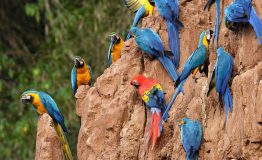
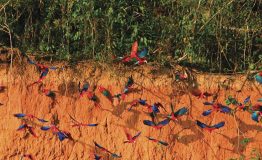
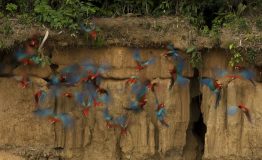
It has been observed that red and green macaws, Grunflugel (ARA chloptera), frequently visit the clay lick at Blanquillo. In my personal opinion, a clay lick can be a social spot where single macaws seek their parenting partners. When feeding from a hand,
macaws are very nervous as predators can easily attack them in the open wall. They are especially vulnerable because their heads are inside a hole while eating the clay.The souls that left this world follow the direction of the Seronhai River. That is the river of those born into the other world.
So, it is a point in the Seronhai that opens in two directions. In the middle is the Yongkatone, a giant macaw.
You have to feed it, and it will let you in to continue its journey to Wanamei, the tree where it will live happily and carefree. That’s why it’s good to feed the one starving because if you don’t feed it in
Yongkatone, it gets bitter and cuts off its head, throwing it to the other side of the river, where there is a fire in Collpa Salvaje – Manu Blanquillo.
Collpa Salvaje – Manu Blanquillo is “Collpa” in Quechua (native mountain language), meaning salt from the earth.
The jungle locals also used it to designate certain areas used by animals indefinitely for a supplement of salts and minerals in their diet.
These help against strong alkaloids and toxins found in plants and many trees of the rainforest.
During the Peru Nature Tour, we will visit one of the most famous “collpas” (Collpa in English) – Collpa Blanquillo!
You have the chance to see a large number of macaws, parrots, and parakeets! Additionally, you can observe the wildlife and the lush vegetation of the Cultural Zone of Manu National Park, Lago Blanco (Cocha), and
Guacamon Silvestre Clay Lick – Manu Blanquillo 7 days:
In Manu, typical macaw salt lick areas are the palm trees (Scheela butyracea), known as Shebonal.
The nutrient content, high aluminum concentration, and low organic matter characterize these areas. Drainage is poor due to the high clay concentration in the soil.
Thus, during the rainy season, the areas easily flood, and during the dry season, they become clay bricks.
It’s no wonder these macaws use high-concentration aluminum clay to cure their stomach pains. Aluminum hydroxide medications are also used in Manu National Park.
BLANQUILLO
Manu Wildlife Center is located in a wooded area that boasts one of the greatest diversities of microhabitats in the Manu Park area.
Firm land, transitional floodplain, varzea and bamboo forests are nearby the cabin, more willow and cane succession, found on river beaches and islands, resulting in one of the highest biodiversity
in the Manu. Over 580 bird species have been recorded in the area between Boca Manu and the lodge and in the surrounding jungle.
The macaws and clay licks of Blanquillo are only 25 minutes by river, and a flock of up to 200 red and green macaws and many hundreds of their smaller relatives come to eat the clay necessary for their digestion.
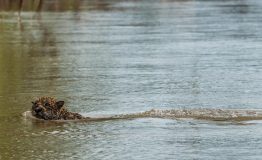
There are two clay licks with floating platforms for wildlife observation, and two families of endangered giant otters inhabit these lakes and small streams.
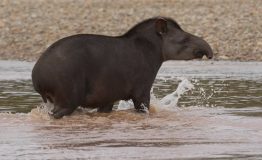
About an hour’s walk from Manu Wildlife Center through the forest, there is a large mammal lick where the tapir, the largest land mammal in South America,
regularly comes in search of minerals. Here is a large hide, equipped with mattresses and mosquito nets for those who want to spend the night comfortably observing these nocturnal creatures.
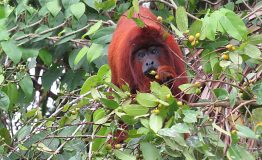
During the day, several species of parrots and parakeets, as well as turkeys, guans, peccaries, and red howler monkeys, visit the clay lick.
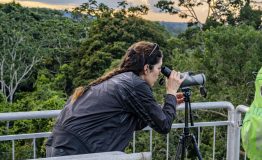
There are 12 species of monkeys that will be observed while walking the trails to the Manu Wildlife Center, including the emperor tamarin, spider monkey, and saki monkey. Access to the canopy is easy, with two
Canopy platforms (30 meters and 40 meters) on large emergent trees accessed by metal stairs.
Travel Manu Macaw Clay Lick – Blanquillo.
One of the largest tropical parks in South America. Located in the South East region of Peru, nestled in the last Andean foothills of the department of Cusco and the jungle of Madre de Dios.
It covers an area of 2 million square hectares of a territory rich in flora and fauna, with a variety of Andean, high Andean, tropical, and subtropical habitats.
This natural paradise recognized by UNESCO as a Biosphere Reserve; It harbors the greatest biological diversity in protected areas of rainforest and several endemic species of cloud forest.
The Wild Trip Manu Blanquillo is a 7-day journey through the heart of Manu National
Park in Peru, offering an immersive exploration of one of the world’s most biodiverse rainforests. The trip features a mix of cultural and natural highlights, including visits to ancient Incan tombs, vibrant colonial towns, and the spectacular Macaw Clay Lick where you can witness large flocks of colorful macaws and other wildlife.
Here’s a brief overview of the itinerary and what you can expect:
Day 1: Cusco to Pilcopata
Start early from Cusco, visiting Ninamarca’s pre-Incan tombs.
Explore Paucartambo, a charming colonial town, and ascend to Tres Cruces viewpoint to see the Cock of the Rock bird.
End the day in Pilcopata Lodge.
Day 2: Atalaya Port to Rainforest Lodge
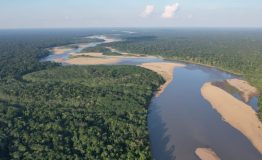
Travel to Atalaya Port, then board a boat to explore the Alto Madre de Dios River, spotting various wildlife such as monkeys, herons, and vultures.
Spend the night at Rainforest Lodge, with an optional night walk.
Day 3: Rainforest Lodge to Maquisapayoq Lodge
A scenic 8-hour boat ride takes you to the Manu Reserved Zone.
Explore the Maquisapayoq Lodge area, home to the red-faced spider monkey and tapir sightings at a clay lick.
Evening walk to observe tapirs at the clay-lick.
Day 4: Macaw Clay Lick and Cocha Blanco Lake
Visit the Macaw Clay Lick to see vibrant macaws.
Explore Cocha Blanco Lake to observe giant river otters and birds like the prehistoric hoatzin.
Return to the lodge for dinner and a caiman search at night.
Day 5: Macaw Clay Lick to Camungo Lake
Early morning visit to the Blanquillo Macaw Clay Lick.
Head to Camungo Lake for stunning views from a 42-meter-high observation tower.
Day 6: Blanquillo to Boca Manu
Boat journey towards Boca Manu, with a stop at Aguas Calientes for a thermal bath.
Continue to the Rainforest Lodge for the night.
Day 7: Return to Cusco
Visit a nearby parrot clay lick before heading back to Atalaya Port.
Private transport returns you to Cusco by evening.
What to Expect:
Wildlife: Giant river otters, capuchin monkeys, colorful parrots, and more.
Macaw Clay Lick: One of the world’s most amazing natural spectacles.
Immersive Nature: Comfortable lodges that allow you to blend into the Amazon environment.
Guided Tours: Expert local guides provide in-depth knowledge about the flora and fauna.
Why Choose This Tour?
Unique Experience: Explore one of the world’s most biodiverse places.
Perfect for All Ages: Suitable for families, adults, and nature lovers of all ages.
Moderate Adventure: Perfect for those looking for adventure without extreme physical demands.


Review Wild Trip – Manu Blanquillo 7 days.